Authors: Isaac Ihinmikaye, Olufemi Oladele Ayodeji, Adetumi Adetunji Subulade, Olalekan Ojo, Temitope Emmanuel Taiwo, Liasu Adeagbo Ahmed.
CITATION: Isaac Ihinmikaye, Olufemi Oladele Ayodeji, Adetumi Adetunji Subulade, Olalekan Ojo, Temitope Emmanuel Taiwo, Liasu Adeagbo Ahmed. (2025). Irreversible ocular sequelae following Lassa fever: clinical evidence from a survivor managed at Fmc Owo isolation Centre, Ondo State, Nigeria. Frontline Professionals Journal 2(11), 232 -241
ABSTRACT
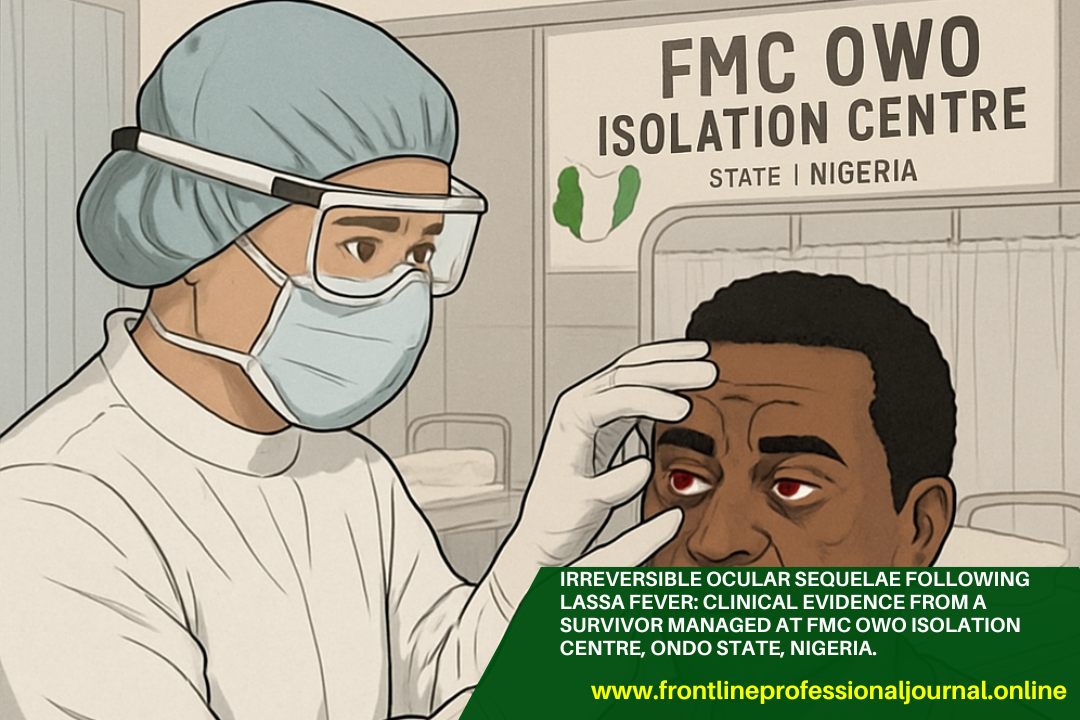
Lassa fever continues to pose a major public health challenge in West Africa. Beyond its well-recognized systemic complications, emerging evidence shows that survivors may develop long-term sequelae affecting vital organs, including the eyes. However, severe visual impairment remains rarely documented and frequently under-recognized. We present the case of a young female survivor of PCR-confirmed Lassa fever who received care at the Infection Control and Research Centre, Federal Medical Centre, Owo, Nigeria. Her acute illness was complicated by coagulopathy and hemorrhagic features, prompting close clinical monitoring during and after treatment.
Although systemic symptoms gradually resolved with ribavirin therapy and supportive care, she developed progressive visual decline in the left eye during convalescence. Ophthalmic evaluations over time revealed vitreous hemorrhage, complicated cataract, and subsequent retinal detachment—leading to irreversible monocular blindness despite late surgical intervention. These findings highlight significant vascular and inflammatory injury likely driven by Lassa virus-induced endothelial damage and coagulation abnormalities.
This case is the first documented irreversible blindness in a Lassa fever survivor, which underscores that Lassa fever is not only an acute viral threat but also a cause of lasting visual disability. Early ophthalmic assessment during hospitalization and structured follow-up for survivors could enable timely detection and intervention for eye complications. Strengthening post-discharge care and further research into viral ocular tropism and targeted therapies are urgently needed to prevent avoidable blindness in Lassa fever survivors.